RDC Restoration Blog · New Jersey
Does Insurance Cover Mold Remediation in New Jersey?
Does insurance cover mold remediation in New Jersey? In most cases the answer hinges on one thing: what caused the mold. When mold grows because of a sudden, accidental water loss that your policy already covers, remediation is frequently paid. When mold traces back to long-term humidity, a leak you left unaddressed, or general wear, carriers usually treat it as a maintenance problem and deny the claim. After 27 years restoring homes and businesses across all 21 New Jersey counties, I have seen the same handful of factors decide almost every mold claim — and most of them are within your control.
Does insurance cover mold remediation? It depends on the cause
Standard New Jersey homeowners policies are built around sudden and accidental damage, not gradual deterioration. That single distinction drives whether mold is covered. If a washing-machine hose bursts, a pipe freezes and splits, or an appliance overflows and mold follows, the mold is usually considered part of that covered water loss. If moisture built up slowly — a drip under the sink that ran for months, chronic bathroom condensation, or seepage through a foundation — the carrier will almost always point to the exclusion for neglect and wear. The mold itself is rarely the question; the source of the water is.
Covered vs. excluded: common New Jersey scenarios
These are the patterns I see most often on New Jersey mold claims:
- Usually covered: mold after a burst or frozen pipe, a sudden appliance failure, an overflowing water heater, or storm water that entered through sudden roof damage.
- Usually excluded: mold from a slow, unrepaired leak, poor ventilation, high indoor humidity, or a maintenance issue you knew about and did not fix.
- Often excluded without an add-on: mold caused by flooding or groundwater. Standard homeowners policies do not cover flood; that requires separate flood insurance, and even then mold terms vary.
- Case by case: mold discovered behind a wall or under flooring where the original water event is unclear. This is exactly where professional documentation decides the outcome.
Because a large share of New Jersey mold begins with water intrusion in below-grade spaces, keeping basements dry is one of the best ways to avoid a claim you might lose. If a wet basement is your recurring problem, basement waterproofing often costs far less than fighting repeat mold, and it removes the moisture source insurers care about.
Mold coverage limits and policy riders
Even when mold is covered, many New Jersey policies cap what they will pay for mold specifically — a sub-limit that is often much lower than the overall dwelling coverage. Some carriers exclude mold entirely unless you carry a mold rider or endorsement. It is worth pulling out your declarations page today, before you ever need it, and looking for the words “fungi,” “mold,” or “microbial” and any dollar limit next to them. If you cannot find clear mold language, call your agent and ask two direct questions: is mold remediation covered when it results from a covered water loss, and is there a separate mold limit? Knowing the answer now keeps you from being surprised during a stressful claim.
How to protect your mold insurance claim
The strongest claims share the same habits. The link between the mold and a covered water event is everything, so build that record from the first hour:
- Document before you clean. Photograph and video the water source and the affected areas before anything is touched or thrown away.
- Report promptly. Notify your carrier as soon as you discover the loss; late reporting is a common reason claims are reduced.
- Mitigate to prevent further damage. Every policy requires you to take reasonable steps to stop the loss from spreading — shut off water, and get professional drying started.
- Keep every receipt. Save invoices for emergency repairs, drying, and lodging if your home is unlivable.
- Do not delay. Water feeds mold within 24 to 48 hours, so waiting can turn a covered water claim into an excluded “you let it grow” argument.
Documentation: the difference between a paid and denied claim
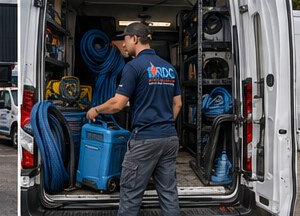
Most New Jersey policies cover sudden, accidental damage, but the outcome of a claim frequently comes down to paperwork. A carrier that cannot see the original water source, the moisture readings, and the extent of the growth will default to the least expensive interpretation — and that usually means “maintenance.” When we respond to a loss, my crews carry moisture meters and thermal cameras, map how far the water traveled, and produce a detailed loss report that ties the mold directly to the covered event. That evidence is often what turns a shaky claim into an approved one. Our restoration work follows the industry standards published by the IICRC, and I hold IICRC (WRT and ASD) certifications along with NORMI and AHERA credentials — the same standards adjusters recognize.
How RDC Restoration works with your insurer
You should not have to become a claims expert in the middle of an emergency. RDC Restoration documents both the water source and the mold for your carrier, produces an itemized scope of work, and bills your insurance company directly wherever possible so you are not floating the cost. We coordinate with your adjuster, explain what we found and why the work is necessary, and back it with photos and readings. Because we dispatch from two central New Jersey hubs in Berkeley Heights (Union County) and Piscataway (Middlesex County), a certified crew reaches most addresses statewide while the damage is still containable — which protects your health and keeps the total claim smaller. If mold has already spread, our mold remediation team contains the area, removes the growth, and, just as important, fixes the moisture source so it does not return. When the root cause is a plumbing or appliance failure, our water damage restoration crews handle the drying that stops mold before it starts.
When to call a certified professional
You can handle a small, isolated spot of surface mold yourself. Call a professional the moment remediation involves contaminated water, an area larger than roughly ten square feet, hidden moisture behind walls or under floors, or any health concern for the people in the home. Certified crews carry containment gear, negative-air equipment, and commercial drying tools a homeowner does not — and we find and fix the source so the problem, and any future claim, does not repeat. If you are unsure how serious your situation is, RDC will tell you honestly, at no charge, before any work begins.
Key takeaways
- Whether insurance covers mold in New Jersey depends on the cause — sudden water loss is usually covered, gradual neglect is not
- Check your policy now for mold sub-limits or a required rider
- Document the water source and mold before you clean
- Report and mitigate promptly to keep the claim covered
- RDC documents the loss and bills your carrier directly — call (908) 253-9000
Facing a mold or water loss in New Jersey right now? RDC Restoration answers 24/7 and works directly with your insurer.
Quick answers
Frequently asked questions
Does homeowners insurance cover mold remediation in New Jersey?
It can, when the mold results from a sudden, covered water loss such as a burst pipe or appliance failure. Mold from gradual leaks, humidity, or neglect is typically excluded, and many policies cap mold payouts or require a rider.
Why would an insurer deny a mold claim?
The most common reasons are gradual damage or neglect, late reporting, a flood-related cause on a non-flood policy, or a mold sub-limit being exceeded. Strong documentation tying the mold to a covered event is the best defense against a denial.
Does RDC Restoration bill my insurance directly?
Yes wherever possible. RDC documents the loss thoroughly, produces an itemized scope, coordinates with your adjuster, and bills your carrier directly so you are not paying out of pocket up front.
Does RDC handle mold remediation in my New Jersey town?
Yes — RDC serves all 21 New Jersey counties, dispatched 24/7 from Berkeley Heights and Piscataway. Call (908) 253-9000 and a certified crew reaches most nearby towns within about an hour.
Is the estimate really free?
Yes — RDC provides free, no-pressure, itemized on-site estimates across New Jersey, backed by 27 years of experience and a 4.9-star, BBB A-rated reputation.
New Jersey’s trusted restoration team.
Water, fire, or mold trouble? RDC Restoration dispatches the nearest crew 24/7, statewide.