RDC Restoration Blog · New Jersey
Appliance Leak Cleanup in New Jersey: Dishwashers, Washers & Water Heaters
Appliance leak cleanup is one of the most common emergency calls we answer, because dishwashers, washing machines, refrigerators, and water heaters quietly sit against your floors and walls day after day. When one of them fails, the water rarely announces itself — it wicks under cabinets, tracks along subfloor seams, and soaks into drywall long before a puddle ever appears in the open. After 27 years restoring New Jersey homes, I can tell you the leaks that cause the most damage are almost never the dramatic ones.
Why appliance leaks do so much hidden damage
A supply hose behind a washing machine or the pan under a water heater can weep for weeks. The volume is small, so it never floods the room — instead it feeds a slow, constant dampness under flooring and inside wall cavities. That is the worst-case scenario for a homeowner, because water sitting in a dark, enclosed space with no airflow is exactly the environment mold needs. By the time a musty smell reaches your nose or a warped floorboard catches your eye, the affected area is usually far larger than what you can see. Thorough appliance leak cleanup means finding every square foot of that moisture, not just wiping up what is visible.
The four appliances that fail most often
Each of these has a predictable failure point, and knowing it helps you catch trouble early:
- Dishwashers — door gaskets, drain hoses, and inlet valves leak toward the cabinet base and under adjacent flooring, where damage hides for months.
- Washing machines — rubber supply hoses are the classic culprit; under constant household water pressure, an aged hose can burst and release water fast.
- Refrigerators — ice-maker and water-dispenser lines run to a plastic connector behind the unit that cracks with age and drips onto the floor you never move the fridge to check.
- Water heaters — tanks corrode from the inside and eventually seep or split, often in a basement or utility closet where the water can reach a finished space.
What professional appliance leak cleanup actually involves
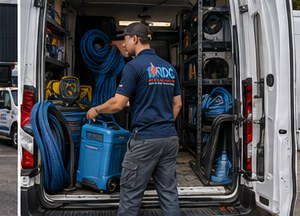
When our crew arrives, the visible cleanup is the easy part. The work that protects your home happens with instruments. We use moisture meters and thermal readings to map how far the water traveled, then extract standing water and set commercial air movers and dehumidifiers to dry the structure back to a documented, safe moisture level — not just dry to the touch. RDC Restoration follows IICRC standards for water damage drying, and our technicians hold IICRC certifications in Water Damage Restoration and Applied Structural Drying. Getting the structure genuinely dry is what separates a clean repair from a mold problem three weeks later. You can read more about our full water damage restoration process for the complete picture.
Why fast response matters
Appliance leak cleanup is a race against the clock. Water begins to feed mold within roughly 24 to 48 hours, and the longer moisture sits inside walls and under floors the more materials it ruins. Because RDC Restoration dispatches from two central New Jersey hubs — Berkeley Heights in Union County and Piscataway in Middlesex County — a certified crew reaches most addresses across all 21 counties while the damage is still contained. Acting quickly protects your family’s health and keeps the total cost down, because a small contained job never becomes a gut-and-rebuild. If you smell must or see discoloration, our mold remediation team can assess and contain it before it spreads further.
Prevention: simple habits that stop the next leak
Most appliance failures we respond to were preventable with a few minutes of attention. Build these into your routine:
- Inspect washer and dishwasher supply hoses once a year and replace them roughly every five years, before the rubber hardens and cracks.
- Upgrade rubber washing-machine hoses to braided stainless-steel lines, which resist bursting under pressure.
- Know where your shutoffs are — each appliance valve and your main — so you can stop the flow the instant something fails.
- Check the pan and connections under your water heater and refrigerator a couple of times a year for rust, mineral crust, or dampness.
- If an appliance sits above or beside a finished basement, watch that ceiling and those walls closely; a small leak upstairs shows up as a stain below. Protecting a finished lower level is also where good basement waterproofing pays off.
When to call a professional
A quick wipe-up after a minor drip is fine to handle yourself. But call for professional appliance leak cleanup the moment the water is contaminated, the wet area is large, moisture has reached behind walls or under flooring, or anyone in the home has a health concern. Certified crews carry moisture meters, commercial drying equipment, and containment gear that a homeowner simply does not have — and just as important, we find and fix the source so the same failure does not repeat. RDC Restoration also documents the loss thoroughly and, on covered claims, bills your insurance carrier directly so you are not caught guessing at the cost.
Key takeaways
- Call (908) 253-9000 for 24/7 appliance leak cleanup across New Jersey
- Act fast — hidden moisture feeds mold within 24 to 48 hours
- Replace supply hoses on a schedule and know your shutoffs
- Document everything for your insurance claim
- Fix the source, not just the symptom
Dealing with an appliance leak in New Jersey right now? RDC Restoration answers 24/7.
Frequently asked questions
How quickly should I start appliance leak cleanup?
Immediately. Water feeds mold within roughly 24 to 48 hours, so the faster you extract and dry, the less damage spreads. RDC Restoration answers 24/7 at (908) 253-9000 and reaches most New Jersey addresses while the damage is still contained.
Can I just dry an appliance leak myself with fans?
A minor surface drip, yes. But household fans do not remove moisture trapped under flooring or inside walls, which is where appliance leaks do their real harm. Certified crews use moisture meters and commercial dehumidifiers to dry the structure to a documented safe level.
Will my homeowners insurance cover appliance leak cleanup?
Sudden and accidental appliance failures are often covered, while slow long-term leaks may not be. RDC documents the loss thoroughly and bills your carrier directly wherever possible, so you are not guessing at the cost.
Does RDC Restoration serve my New Jersey town?
Yes — RDC serves all 21 New Jersey counties, dispatched 24/7 from Berkeley Heights and Piscataway. See our service areas or call (908) 253-9000.
What if the leak already caused mold?
Our IICRC- and NORMI-certified technicians can contain and remediate mold and correct the moisture source so it does not return. Learn more about our mold remediation service.
An appliance leak is stressful, but it is also one of the most controllable losses we handle when you act quickly. If you have a dishwasher, washer, refrigerator, or water heater leaking right now, call RDC Restoration at (908) 253-9000 for 24/7 emergency appliance leak cleanup, or contact us for a free on-site estimate anywhere in New Jersey.
New Jersey’s trusted restoration team.
Water, fire, or mold trouble? RDC Restoration dispatches the nearest crew 24/7, statewide.