
RDC Restoration Blog · New Jersey
Signs of Mold in Basement: What New Jersey Homeowners Should Watch For
The earliest signs of mold in basement spaces almost always reach your nose before they reach your eyes — a persistent musty, earthy odor that lingers no matter how often you clean. By the time you spot fuzzy patches or discoloration, a colony has usually been growing quietly for days or weeks. Knowing what to look for lets New Jersey homeowners catch a moisture problem early, before it spreads into framing, drywall, and the air your family breathes.
Common signs of mold in basement spaces
Basement mold rarely appears overnight, and it tends to show the same warning signals in home after home across New Jersey. If you notice several of the following together, treat it as a moisture problem that needs attention rather than a cosmetic nuisance:
- A musty, damp smell that returns after you air the space out — often the first and most reliable of the signs of mold in basement areas.
- Fuzzy, powdery, or slimy patches in white, gray, green, brown, or black on walls, joists, or stored items.
- Discoloration or staining that spreads or darkens over time, especially near the floor line or in corners.
- Condensation on cold-water pipes, foundation walls, or windows, signaling humidity high enough to feed mold.
- Efflorescence — a white, chalky crust on concrete — which is not mold itself but proves moisture is moving through the walls.
- Peeling paint, warped paneling, or bubbling drywall, all clues that water is trapped behind the surface.
- Worsening allergy or respiratory symptoms that flare up when you spend time downstairs and ease when you leave.
Why New Jersey basements are so prone to mold
Below-grade spaces are the perfect storm for mold: they trap humidity, stay cool, and sit surrounded by damp soil. New Jersey adds its own pressures — a high water table across much of the state, clay-heavy soils that hold water against foundations, and a wet coastal climate punctuated by nor’easters and summer downpours. Every heavy rain pushes hydrostatic pressure against basement walls, and moisture wicks through concrete and block far more easily than most owners realize. Mold only needs three things to thrive: moisture, a food source, and time. Basements supply all three, because organic materials like cardboard boxes, wood framing, paper-faced drywall, carpet, and fabric all become food once they stay damp.
That is why chasing the visible patch alone never works. If you clean mold off a wall but leave the water intrusion in place — a cracked foundation, a failing sump pump, poor grading, or a slow plumbing leak — the colony returns within weeks. Lasting results come from pairing professional mold remediation with a real fix for the water source, which is often where basement waterproofing comes in.
Where basement mold likes to hide
Some of the worst growth never shows on an open wall. When we inspect New Jersey basements, the hidden spots that hide mold most often include:
- Behind finished drywall and paneling, where paper facing feeds it in the dark.
- Under carpet and padding that stayed wet after a seepage event or minor flood.
- Inside the sill plate and rim joists where the foundation meets the framing.
- Around water heaters, washing machines, and HVAC condensate lines.
- In insulation, which can hold moisture and hide colonies for months.
Because so much basement mold is out of sight, a musty smell with no visible patch is still a real warning. A proper inspection with moisture meters and thermal imaging confirms what is actually happening behind the surfaces.
Health signs mold may be affecting your family
Mold does not just damage a building — it affects the people inside it. Spores and the airborne particles they release can trigger sneezing, nasal congestion, coughing, itchy or watery eyes, skin irritation, and headaches. People with asthma, allergies, infants, older adults, and anyone with a weakened immune system tend to react first and most strongly. A telling pattern is symptoms that worsen at home, and specifically when you are near or below the basement, then improve when you are away for a day or two. If your household is noticing that rhythm alongside any of the visual signs of mold in basement areas above, it is worth acting rather than waiting.
When to call a professional
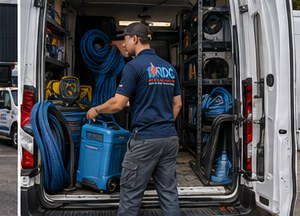
A homeowner can safely wipe down a small patch of surface mold — roughly under about ten square feet — on a hard, non-porous surface. Beyond that, remediation belongs to a certified crew. Call a professional the moment the situation involves a large area, contaminated or gray water, mold hidden behind walls or under floors, mold on porous materials like drywall and insulation, or any health concern in the home. Certified technicians carry HEPA filtration, negative-air containment, commercial drying equipment, moisture meters, and antimicrobial treatments that a household simply does not have. Reputable restoration companies follow IICRC industry standards for containment, removal, and clearance so the work is done safely and does not spread spores through the rest of the house. RDC Restoration’s technicians hold IICRC certifications in Water Restoration (WRT) and Applied Structural Drying (ASD), plus NORMI and AHERA credentials for mold and air quality.
How RDC handles basement mold in New Jersey
Restoration is a race against time — mold can take hold within 24 to 48 hours of materials getting wet, and the longer contamination sits, the more it spreads and the higher the cost climbs. Because RDC Restoration dispatches from two central hubs in Berkeley Heights (Union County) and Piscataway (Middlesex County), a certified crew reaches most New Jersey addresses quickly, while the damage is still containable. A typical basement job follows a clear path: inspect and identify the moisture source, set up containment and negative air, remove and bag affected porous materials, HEPA-vacuum and treat surviving surfaces, dry the structure with commercial equipment, and verify the space is clean before rebuilding. When an underlying leak or intrusion is the real culprit, we also address the water problem — often coordinating water damage restoration or waterproofing — so the mold does not simply grow back. RDC serves all 21 New Jersey counties, provides free itemized on-site estimates, and bills insurance directly on covered losses. Call (908) 253-9000 any time, day or night.
Key takeaways
- A lingering musty smell is usually the first sign — trust your nose before your eyes.
- Fuzzy patches, staining, condensation, and efflorescence all point to a moisture problem.
- Fix the water source, not just the visible mold, or it comes back.
- Call a pro for large areas, hidden mold, porous materials, or health concerns.
- Call (908) 253-9000 for 24/7 help across New Jersey.
Seeing the signs of mold in your basement right now? RDC Restoration answers 24/7.
Quick answers
Frequently asked questions
What are the first signs of mold in a basement?
The earliest sign is almost always a musty, earthy smell that keeps coming back even after you clean and ventilate. Visible fuzzy or discolored patches, condensation, and worsening allergy symptoms downstairs usually follow. If you notice several together, treat it as a moisture problem worth inspecting.
Is basement mold dangerous to my health?
It can be. Mold spores may trigger congestion, coughing, itchy eyes, skin irritation, and headaches, and they hit people with asthma, allergies, infants, and older adults hardest. Symptoms that worsen at home and ease when you leave are a common warning sign.
Can I remove basement mold myself?
A small patch under about ten square feet on a hard, non-porous surface can be cleaned by a homeowner. Larger areas, contaminated water, porous materials like drywall, hidden mold, or any health concern call for certified professionals with containment and HEPA equipment. Call (908) 253-9000 if you are unsure.
Why does mold keep coming back in my basement?
Because the water source was never fixed. Cleaning the surface without addressing a cracked foundation, failing sump pump, poor grading, or a plumbing leak lets the colony regrow within weeks. Lasting results pair remediation with a real moisture fix such as basement waterproofing.
Does RDC Restoration handle basement mold in my New Jersey town?
Yes — RDC serves all 21 New Jersey counties, dispatched 24/7 from Berkeley Heights and Piscataway, with free on-site estimates and direct insurance billing on covered losses. Call (908) 253-9000.
New Jersey’s trusted restoration team.
Water, fire, or mold trouble? RDC Restoration dispatches the nearest crew 24/7, statewide.