
RDC Restoration Blog · New Jersey
Black Mold vs Regular Mold: Should NJ Homeowners Worry?
When homeowners ask me about black mold vs regular mold, they are usually looking at a dark patch on a wall and wondering whether their family is in danger. The honest answer is that color alone cannot tell you — not all dark mold is toxic “black mold,” and not every hazardous mold is black. The only reliable way to know what you are dealing with is testing, and in every case, indoor mold growth is a signal that moisture is getting somewhere it should not.
After 27 years walking New Jersey basements, attics, and bathrooms, I have learned that the panic over color is usually misplaced — but the underlying moisture problem almost never is. Here is an honest, no-hype breakdown of what the difference actually means for your home and your health.
Black mold vs regular mold: what the color actually tells you
The phrase “black mold” almost always refers to Stachybotrys chartarum, a slimy, greenish-black mold that thrives on constantly wet cellulose — drywall, ceiling tiles, and wood that has stayed damp for days. But here is the catch: dozens of harmless or common household molds are also dark, and some genuinely troublesome molds like Aspergillus and Penicillium show up green, gray, white, or yellow. Color is one of the least reliable ways to judge risk. What actually matters is how much mold is present, where the moisture is coming from, and whether anyone in the home is experiencing symptoms.
What black mold (Stachybotrys) really is
Stachybotrys needs sustained moisture to establish itself, which is why it tends to appear after a slow plumbing leak, an unnoticed roof drip, or a chronically damp basement. It does not spread through a bone-dry house on its own. When people talk about “toxic black mold,” they are referring to mycotoxins some strains can produce under certain conditions. The science on health effects is still debated, but the practical takeaway is simple: a large or established colony should be contained and removed by trained technicians so spores are not driven through the rest of the home during cleanup.
Why regular household mold still matters
Do not let “it is probably just regular mold” talk you into ignoring it. Common molds still degrade drywall, insulation, and framing, still trigger allergies and asthma, and — most importantly — still mean you have a moisture problem. New Jersey’s humid summers and older housing stock make mold one of the most frequent calls we get. Whether the growth is black, green, or gray, the remediation playbook is the same: find the water, stop it, contain the area, remove the affected material, and dry everything thoroughly.
Health effects NJ homeowners should know about
For most healthy adults, brief exposure to a small patch of mold causes little more than irritation. The people who need to be more cautious are infants, older adults, and anyone with asthma, allergies, or a weakened immune system. Common complaints include a stuffy or runny nose, itchy eyes, coughing, wheezing, and worsening asthma symptoms that ease when you leave the house. None of these prove you have Stachybotrys specifically — but if symptoms track with time spent at home, that is a strong reason to investigate. If your symptoms feel allergy-driven, our guide on mold testing & remediation explains how professional testing pins down the cause.
How to tell the difference: testing beats guessing
You cannot identify a mold species by staring at it, and neither can I — that is what lab analysis is for. A proper inspection combines a visual assessment, moisture-meter readings behind walls and under floors, and air or surface sampling sent to an accredited lab. That process tells you the type of mold, the concentration, and often where hidden moisture is feeding it. RDC follows IICRC standards for inspection and remediation, and our founder holds IICRC (WRT, ASD), NORMI, and AHERA certifications. When the black mold vs regular mold question actually affects a real decision — a home sale, a health concern, a visible colony — testing is worth every penny because it replaces guessing with a plan.
When to call a professional
A patch of mold smaller than about a square foot on a hard, non-porous surface is usually something a homeowner can clean safely with proper ventilation and protection. Call a certified professional the moment any of these are true:
- The affected area is larger than roughly 10 square feet
- Mold is tied to contaminated water — a sewage backup or flood
- You can smell must but cannot see the source (hidden growth behind walls, under floors, or in HVAC)
- Anyone in the home has asthma, allergies, or a compromised immune system
- It keeps coming back after you clean it — a sign the moisture source was never fixed
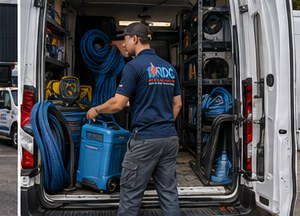
Certified crews bring moisture meters, HEPA air scrubbers, commercial drying equipment, and negative-air containment that a homeowner simply does not have. Just as important, we trace the problem to its source. If a wet basement is feeding the growth, no amount of surface cleaning will hold — that is a basement waterproofing conversation, not just a mold one.
Why fast response matters in New Jersey
Restoration is a race against time. Mold can begin colonizing damp material within 24 to 48 hours, which is why a plumbing leak or storm intrusion should never sit over a weekend. The faster the water is removed and the structure dried, the smaller the eventual mold problem — and the lower the total repair cost. Because RDC Restoration dispatches from two central hubs, Berkeley Heights in Union County and Piscataway in Middlesex County, a certified crew reaches most New Jersey addresses while damage is still containable. If your mold traces back to a burst pipe or appliance failure, our water damage restoration team handles the drying and the mold in one coordinated visit. We serve all 21 New Jersey counties — you can confirm coverage on our service areas page or by calling (908) 253-9000.
Insurance and documentation
Most New Jersey homeowners policies cover mold when it results from a sudden, accidental event that is otherwise covered — a burst pipe, for example — but rarely cover mold that grew from long-term neglect or deferred maintenance. The outcome of a claim often comes down to documentation. Photograph everything before cleanup begins, keep receipts, and mitigate promptly, because policies require you to prevent further loss once you know about it. RDC produces a detailed, itemized loss report and bills your carrier directly wherever possible, which strengthens and speeds your claim.
Key takeaways
- Color cannot confirm black mold vs regular mold — only testing can
- Any indoor mold means you have a moisture problem to solve
- Call (908) 253-9000 for 24/7 help across New Jersey
- Act fast — mold can take hold within 24–48 hours
- Document everything for your insurance claim
- Fix the source, not just the surface
Worried about black mold in your New Jersey home right now? RDC Restoration answers 24/7.
Quick answers
Frequently asked questions
Is black mold more dangerous than regular mold?
Not necessarily. Some strains of “black mold” (Stachybotrys) can produce mycotoxins, but many dark molds are harmless and some non-black molds cause real allergy and asthma symptoms. Risk depends on the amount of mold and who is exposed — not the color. When it matters, testing settles the question. Call RDC at (908) 253-9000.
Can I tell black mold from regular mold just by looking?
No. Color and texture are unreliable indicators, and even professionals confirm species through lab analysis of an air or surface sample. If you have a visible colony or health concerns, get it tested rather than guessing.
Does RDC Restoration handle mold remediation in my New Jersey town?
Yes — RDC serves all 21 New Jersey counties for mold remediation, dispatched 24/7 from Berkeley Heights and Piscataway. Call (908) 253-9000.
Will my insurance cover mold removal?
Most NJ policies cover mold caused by a sudden, covered event like a burst pipe, but not mold from long-term neglect. RDC documents the loss thoroughly and bills your carrier directly wherever possible to support your claim.
Has RDC done this before?
Yes. RDC Restoration has 27 years of experience, IICRC, NORMI, and AHERA certifications, a BBB A rating, and a 4.9-star reputation among New Jersey families and businesses.
New Jersey’s trusted restoration team.
Water, fire, or mold trouble? RDC Restoration dispatches the nearest crew 24/7, statewide.