
RDC Restoration Blog · New Jersey
Can You Remove Mold Yourself, or Do You Need a Pro?
You can often remove mold yourself when it is a small, surface patch under about ten square feet on a hard, non-porous surface — but the moment mold spreads into drywall, insulation, HVAC ducts, or grows out of a water leak, it becomes a job for a certified professional. After 27 years restoring New Jersey homes, the single most important thing I tell homeowners is this: cleaning the stain you can see is easy, but stopping mold from coming back means finding and fixing the hidden moisture feeding it.
Can you remove mold yourself? The ten-square-foot rule
Industry guidance draws a practical line at roughly ten square feet — about the size of a bathroom vanity or a small closet wall. Under that threshold, a healthy adult can usually remove mold yourself with the right protection and a little patience. Above it, or anywhere the growth is hidden, the risk of scattering spores through the rest of the house outweighs the savings of doing it alone. That line exists because disturbing mold releases millions of microscopic spores into the air, and without containment those spores settle in rooms that were never affected in the first place.
Before you scrub anything, ask three questions: Is the patch small and on a hard surface like tile, glass, or sealed metal? Do you know exactly what is keeping it wet? And is everyone in the household healthy, with no asthma, allergies, or weakened immune systems? If the answer to all three is yes, a careful DIY cleanup is reasonable. If any answer is no, treat it as a professional job.
What a safe DIY mold cleanup requires
- An N95 respirator, gloves, and eye protection — spores irritate lungs, skin, and eyes
- A non-porous surface only: tile, grout, glass, hard plastic, or finished metal
- Detergent and water, not bleach — scrubbing physically removes mold better than bleaching a stain lighter
- A fan venting to the outside and the door to the rest of the home kept closed
- The actual moisture source fixed first — a leaky trap, a sweating pipe, a run of condensation — or the mold simply returns
When to call a professional instead
Call a professional the moment the situation crosses out of that small, dry, non-porous box. In practice, that means any of the following: the affected area is larger than ten square feet, the mold grew from a burst pipe, sewage backup, or flood, you can smell mold but cannot see the source, the growth is inside walls or under flooring, or anyone in the home has respiratory issues. When mold rides in on contaminated water, the water category matters as much as the mold itself — that is squarely water damage restoration territory, not a weekend project.
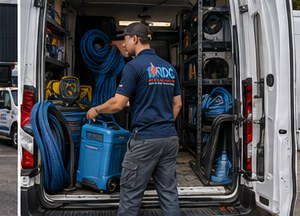
Certified crews bring tools a homeowner does not own: calibrated moisture meters and thermal cameras that reveal wet cavities behind finished walls, negative-air machines and plastic containment that keep spores from migrating, commercial HEPA air scrubbers, and drying equipment sized to pull an entire structure back below the moisture level mold needs to survive. Just as important, an experienced technician traces the problem to its source and confirms the air is clean before the containment comes down.
Why porous materials cannot simply be cleaned
Mold sends root-like structures called hyphae into anything soft and organic. On tile you can wipe it away; in drywall, carpet, ceiling tile, and insulation those roots grow past the surface, and no amount of scrubbing reaches them. That is why professional remediation removes and replaces porous materials rather than trying to salvage them. Homeowners who paint over moldy drywall or shampoo a moldy carpet almost always see it return within weeks, because the living colony underneath was never actually removed — only hidden.
How professional mold remediation works
Reputable New Jersey remediation follows the IICRC S520 standard, the nationally recognized protocol for mold cleanup. In broad strokes, a proper job moves through the same stages every time:
- Inspection and moisture mapping — find every wet cavity and the source feeding it
- Containment — seal the work area and run negative air so spores cannot escape
- Removal — extract porous materials that cannot be saved and HEPA-vacuum the rest
- Cleaning and antimicrobial treatment of salvageable structure
- Drying — return the space to a normal, stable moisture level
- Verification — confirm the area is dry and clean before rebuilding
RDC Restoration’s technicians hold IICRC certifications in Water Damage Restoration and Applied Structural Drying, along with NORMI and AHERA training, so the same crew that removes the mold also resolves the water problem that caused it. If the moisture is chronic — a damp foundation, seasonal seepage — the real fix may be basement waterproofing rather than repeated cleanups.
What mold remediation costs in New Jersey
There is no honest flat price, because cost tracks the size of the affected area, how contaminated the water or damage is, which materials must be removed, and how quickly work begins. A small, contained job is far less than a large or delayed one — and delay is expensive, because every day mold spreads it adds square footage, replacement materials, and drying time to the bill. RDC provides free, itemized on-site estimates, and on covered losses we document everything and bill your insurance carrier directly, so you are not guessing at the number. You can request an estimate here or read more about our New Jersey crews.
Why fast response matters in New Jersey
Restoration is a race against the clock. Mold can begin colonizing wet material within 24 to 48 hours, so the gap between a leak and the cleanup often decides whether you have a minor patch you can remove yourself or a wall you have to open. Because RDC dispatches around the clock from hubs in Berkeley Heights (Union County) and Piscataway (Middlesex County), a certified crew reaches most New Jersey addresses while the damage is still contained — which protects your family’s health and keeps the total cost down. If you are staring at active mold or standing water right now, call (908) 253-9000 before it spreads.
Key takeaways
- You can remove mold yourself only if it is under ten square feet on a hard, non-porous surface
- Porous materials — drywall, carpet, insulation — must be removed, not cleaned
- Any water-loss mold, hidden mold, or health concern is a professional job
- Fix the moisture source or the mold returns every time
- Call (908) 253-9000 for 24/7 help across all 21 NJ counties
Dealing with this in New Jersey right now? RDC Restoration answers 24/7.
Quick answers
Frequently asked questions
How much mold can I safely remove myself?
As a rule of thumb, a patch under about ten square feet on a hard, non-porous surface is safe to remove yourself with an N95 mask, gloves, and eye protection. Anything larger, hidden in walls, or tied to a water leak should go to a certified professional. Call RDC at (908) 253-9000 if you are unsure.
Does bleach kill mold on drywall?
No — bleach may lighten the stain, but it cannot reach the mold roots inside porous drywall, which must be removed and replaced. Scrubbing with detergent works on hard surfaces, but soft materials need remediation.
Does RDC Restoration handle mold remediation in my New Jersey town?
Yes — RDC serves all 21 New Jersey counties for mold remediation, dispatched 24/7 from Berkeley Heights and Piscataway. Call (908) 253-9000.
Will removing mold myself save money?
Only on genuinely small jobs. Disturbing a larger colony without containment scatters spores and usually turns a contained cleanup into a whole-room remediation, costing far more than calling a pro early. RDC gives free, itemized on-site estimates.
Does RDC bill my insurance?
Yes — RDC documents the loss thoroughly and bills your carrier directly wherever possible, and provides a free estimate before any work begins.
New Jersey’s trusted restoration team.
Water, fire, or mold trouble? RDC Restoration dispatches the nearest crew 24/7, statewide.