
RDC Restoration Blog · New Jersey
How Fast Does Mold Grow After Water Damage?
How fast does mold grow after water damage? In most cases mold can begin colonizing within 24 to 48 hours of water exposure, and visible growth often appears within three to five days. That narrow window is exactly why the speed of extraction and drying — not the cleanup that comes later — is the single biggest factor in whether a wet New Jersey home stays healthy or turns into a remediation job.
In 27 years of drying out flooded basements, burst-pipe kitchens, and storm-soaked crawl spaces across all 21 New Jersey counties, I have watched the same pattern play out again and again: the homeowner who called within hours almost never sees mold, and the one who waited a long weekend almost always does. Below is the honest, field-tested timeline our crews work against every day, and what you can do to stay ahead of it.
How fast does mold grow, hour by hour?
Mold does not need much — just moisture, an organic food source, and time. Because microscopic mold spores are already floating in the air of every building, the clock starts the moment materials get wet. Here is the general progression we see in the field:
- 0–24 hours: Water wicks into drywall, carpet padding, baseboards, and subfloor. No mold yet, but the conditions are being set. This is the ideal window to extract and dry.
- 24–48 hours: Spores that land on damp organic surfaces begin to germinate. You usually cannot see anything, but colonization has started.
- 3–5 days: Active colonies form. You may notice a musty odor before you ever see a spot.
- 1–3 weeks: Visible growth spreads across surfaces and pushes into wall cavities, insulation, and framing, where it is far harder and costlier to remove.
Those are typical ranges, not guarantees. The exact speed depends on temperature, humidity, and material — which is why two identical-looking leaks can produce very different outcomes.
Why New Jersey’s climate speeds mold up
The 24-to-48-hour rule of thumb assumes average indoor conditions. New Jersey summers are anything but average. Mold thrives between roughly 60°F and 80°F with relative humidity above 60 percent — a description that fits most of the state from June through September. A few local factors push growth toward the fast end of the range:
- High summer humidity. Muggy Jersey air keeps materials from drying on their own, so a leak that might air-dry in a desert climate stays wet here.
- Below-grade basements. Cool foundation walls and poor airflow trap moisture, making basements the number-one mold call we get.
- Older housing stock. Many NJ homes have plaster, cellulose insulation, and wood framing that hold water and feed mold.
- Storm and flood events. Nor’easters and remnants of tropical systems dump water faster than a home can shed it.
Understanding how fast does mold grow in these conditions is the reason our dispatch hubs in Berkeley Heights (Union County) and Piscataway (Middlesex County) run a 24/7 line — a Saturday-morning leak cannot wait until Monday.
The materials that grow mold fastest
Not everything in your home is equally vulnerable. Porous, organic materials are mold’s favorite food and hold water the longest:
- Drywall and paper facing — wicks water upward and feeds mold on both sides.
- Carpet and carpet padding — padding acts like a sponge and hides moisture underneath.
- Insulation — fiberglass and cellulose trap water against framing.
- Wood framing, trim, and subfloor — slow to dry and structurally important.
- Ceiling tiles, upholstery, and stored cardboard — often overlooked until they smell.
Non-porous surfaces like glass, metal, and sealed tile can usually be wiped down and saved. The real question is always what is hiding behind the wall or under the floor.
How professional drying beats the mold clock
The most reliable mold prevention is not a spray or a sealant — it is removing the water before spores can germinate. When RDC responds to water damage in New Jersey, we work fast and by the numbers:
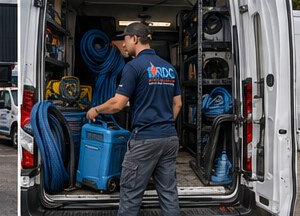
- Extraction. Truck-mounted and portable units pull standing water out immediately.
- Moisture mapping. We use moisture meters and thermal imaging to find water hiding inside walls and under floors — the spots homeowners miss.
- Structural drying. Air movers and commercial dehumidifiers create the airflow and low humidity that pull moisture back out of framing and drywall.
- Monitoring. We track moisture readings daily until materials return to a dry standard, following IICRC water-damage guidelines.
If growth has already taken hold, drying alone is not enough. That is when we move to containment, negative air, and HEPA-filtered mold remediation to remove the colony and clean the air — work our team performs to IICRC and NORMI standards.
What to do in the first 24 hours
If you have a fresh leak or flood, your actions in the first day matter more than anything a contractor does later. While you wait for a crew:
- Stop the water source if you safely can, and shut off power to affected areas.
- Remove standing water and lift wet rugs, cushions, and small furniture off the floor.
- Get air moving with fans and open windows only if outdoor humidity is low.
- Do not paint, seal, or lay new flooring over anything still damp — you will trap moisture and feed mold.
- Photograph everything for your insurer before you move or discard it.
- Call a professional the moment you smell must or see discoloration.
Recurring water is often a foundation problem. If your basement floods more than once, ask about basement waterproofing so you are not fighting mold every storm season.
Frequently asked questions
How fast does mold grow after a flood or burst pipe?
Under typical indoor conditions, mold can start colonizing within 24 to 48 hours and become visible within three to five days. In humid New Jersey summers it can move toward the faster end of that range, which is why same-day extraction matters so much.
Can I dry out water damage myself before mold grows?
For a small, contained spill caught immediately, sometimes yes. For flooding, sewage, or any water inside walls and under floors, DIY fans rarely reach the hidden moisture in time. Professional drying with commercial air movers and dehumidifiers is far more reliable inside the 24-to-48-hour window.
Does drying the surface mean the mold risk is gone?
Not necessarily. Surfaces can feel dry while framing, insulation, and subfloor stay saturated. We verify with moisture meters and thermal imaging and dry to a measured standard rather than trusting the touch test.
Does RDC test for mold in New Jersey?
Yes. RDC offers NORMI-certified mold inspection and air-quality testing across all 21 NJ counties, so you know whether you are dealing with prevention or active remediation before any work begins.
Will my insurance cover mold from water damage?
It often depends on the source and how quickly you acted, which is another reason to respond fast. RDC bills your carrier directly and documents the loss to support your claim.
Wet materials in your New Jersey home right now? The mold clock is already running — RDC Restoration answers 24/7 and can dispatch the nearest crew statewide. Call (908) 253-9000 or request help online.
New Jersey’s trusted restoration team.
Water, fire, or mold trouble? RDC Restoration dispatches the nearest crew 24/7, statewide. Call (908) 253-9000.