
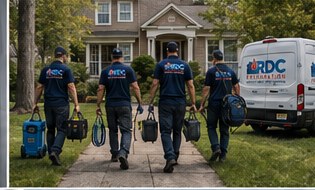
RDC Restoration Blog · New Jersey
The Hidden Smoke Damage You Can’t See After a Fire
Hidden smoke damage is the part of a fire most New Jersey homeowners never think about — and it is often the part that costs the most. After the flames are out and the visible mess is cleaned up, a fire is not finished with your home. Smoke and soot travel far beyond the burn area and keep causing harm long after the last ember cools.
In 27 years restoring homes across all 21 New Jersey counties, I have walked into countless houses where the family thought the worst was over because the burned room was cleaned up. What they could not see — soot inside the walls, residue coating the furnace, odor buried in the carpet padding — was still doing damage every hour it sat there. For a plain-English overview of post-fire safety, see Ready.gov’s home-fire guidance, then call RDC Restoration for hands-on help here in New Jersey.
How smoke travels where you can’t see it
Smoke behaves like a gas. Driven by heat and by your home’s own air currents, it seeks out cooler surfaces and every gap it can find — flowing into wall cavities, up into the attic, through the HVAC ducts, and into rooms the fire never touched. Soot particles are microscopic, so they slip through the smallest openings and settle on the inside of walls, behind outlets, inside cabinets, and on the coils of your heating and cooling system.
This is why a fire contained to one room can leave residue and odor across an entire New Jersey home. It is also why our older housing stock — the century-old colonials and split-levels common from Bergen County down to the Shore — tends to hold smoke so stubbornly: balloon-framed wall cavities, retrofit ductwork, and layers of porous plaster give soot countless places to hide. What you can see and wipe away is only a fraction of the actual damage.
Where hidden smoke damage settles
- Inside wall cavities and behind trim, where soot coats framing and insulation completely out of view.
- In the HVAC system, which then redistributes soot and odor to every room each time the furnace or air handler runs.
- Inside cabinets, closets, drawers, and along the tops of doors, where residue collects on surfaces you rarely touch.
- On and inside electronics, where corrosive residue attacks circuit boards from within long after the fire.
- In porous materials — carpet padding, upholstery, curtains, mattresses — that trap odor deep in the fibers.
- On cool exterior walls, window glass, and behind picture frames, where the residue leaves a telltale shadow.
Why hidden smoke damage keeps causing harm
Corrosion that never stops
Soot is acidic. Left in place it tarnishes metal, etches glass and mirrors, discolors grout and countertops, and eats into the electronics it has coated. This damage compounds for days and weeks after the fire, which is exactly why soot damage gets worse the longer you wait to have it professionally removed. A doorknob or appliance that could have been cleaned in the first 48 hours may be permanently pitted a month later.
Odor that comes back
Smoke odor is not just on surfaces — it is embedded in porous materials throughout the house. That is why a home can smell fine on a cool day and reek again when it warms up or the humidity rises, as the trapped compounds re-release into the air. Surface cleaning and store-bought deodorizers only mask it. Real odor removal reaches the source, which our post on how professionals remove smoke odor after a fire explains in detail.
Hidden moisture and the mold that follows
Many people forget that a fire almost always comes with water — from the fire department’s hoses, from the sprinkler system, or from a burst pipe once the heat is gone. That water soaks into the same wall cavities and subfloors where soot is hiding, and within 24 to 48 hours it can seed mold growth. This is why thorough fire recovery so often overlaps with water damage restoration and, when moisture is caught late, mold remediation. Treating the smoke without addressing the water leaves a second problem growing behind your walls.
Health effects
Fine soot particles and the chemical residue in smoke are respiratory irritants. When they settle in your ductwork and get recirculated, they can aggravate asthma, allergies, and breathing problems for everyone in the home — long after the visible cleanup is done. Infants, older adults, and anyone with a lung condition are the most vulnerable.
Why DIY cleanup misses hidden smoke damage
A homeowner with a sponge can clean the visible soot off a wall, but cannot reach inside the wall cavity, cannot clean the HVAC coils and ducts, and cannot neutralize odor embedded in porous materials. Worse, wiping soot with the wrong method grinds the acidic residue deeper and can permanently stain a surface that could have been restored. This is not a shortcoming of effort — hidden smoke damage requires HEPA equipment, professional chemistry, and trained technique that a household simply does not have.
How professionals find and remove hidden damage
A trained restoration team assesses the full path the smoke traveled, not just the burn room. At RDC, our crews are IICRC-certified and we follow the cleaning and drying standards published by the IICRC so nothing is guessed at. Proper fire and smoke damage restoration includes:
- Inspecting hidden areas — wall cavities, the attic, and the HVAC system — to map the true extent of the damage.
- HEPA filtration and specialized cleaning matched to each surface and material.
- Cleaning the ductwork so the system stops recirculating soot and odor through the house.
- Professional deodorization — thermal fogging, ozone, or hydroxyl treatment — that neutralizes odor at the source.
- Checking for hidden moisture with meters and thermal imaging so no wet cavity is left to grow mold.
- Contents cleaning to restore belongings the smoke reached, from clothing to electronics.
- Full documentation of the hidden damage for your insurance claim — something homeowners frequently underestimate on their own.
If you have just been through a fire, our guide to the first steps after a house fire in New Jersey covers what to do before the crew arrives.
Fast, local help across New Jersey
Because hidden smoke damage gets worse by the hour, response time matters. RDC dispatches around the clock from hubs in Berkeley Heights (Union County) and Piscataway (Middlesex County), and we cover every one of New Jersey’s 21 counties — you can see our full coverage on the service areas page. We are BBB A-rated with a 4.9-star reputation, we bill your insurer directly, and every job is led by IICRC-certified technicians. You can learn more about our team and credentials on the about RDC Restoration page.
The takeaway is simple: never assume a fire’s damage stops at what you can see. RDC Restoration has spent 27 years uncovering and reversing hidden smoke damage in New Jersey homes, and we answer 24/7 with direct insurance billing. Call (908) 253-9000 for a free inspection so nothing gets missed.
Frequently asked questions
How do I know if I have hidden smoke damage?
Telltale signs include a smoke smell that returns on warm or humid days, soot shadows on cool walls or around vents, tarnishing metal or etched glass, and worsening allergy or breathing symptoms. A professional inspection maps the full extent, including the areas you cannot see. Call (908) 253-9000 for a free assessment.
Can smoke damage spread to rooms the fire never reached?
Yes. Smoke moves like a gas through wall cavities, ductwork, and air currents, settling in rooms far from the fire. A blaze contained to one room routinely leaves soot and odor throughout the entire house.
Why does the smoke smell keep coming back after cleaning?
Because the odor is embedded in porous materials and hidden areas, not just on the surfaces you cleaned. As temperature and humidity rise, trapped compounds re-release into the air. Only source-level deodorization removes it for good.
Is hidden smoke damage covered by insurance?
Typically yes, as part of a fire claim, but it is easy to under-document on your own. A professional restoration team identifies and records the hidden damage so it is properly included in your claim rather than discovered later. RDC bills your insurer directly.
How soon should I have my home inspected after a fire?
As soon as the property is safe to enter. Soot is acidic and corrosive, so the first 24 to 48 hours make a real difference in what can be saved. The sooner a certified crew maps the hidden smoke damage, the less permanent loss you face.
FAQs
Common questions
How do I know if I have hidden smoke damage?
Telltale signs include a smoke smell that returns on warm or humid days, soot shadows on cool walls or around vents, tarnishing metal or etched glass, and worsening allergy or breathing symptoms. A professional inspection maps the full extent, including areas you cannot see.
Can smoke damage spread to rooms the fire never reached?
Yes. Smoke moves like a gas through wall cavities, ductwork, and air currents, settling in rooms far from the fire. A blaze contained to one room routinely leaves soot and odor throughout the entire house.
Why does the smoke smell keep coming back after cleaning?
Because the odor is embedded in porous materials and hidden areas, not just on the surfaces you cleaned. As temperature and humidity rise, trapped compounds re-release into the air. Only source-level deodorization removes it for good.
Is hidden smoke damage covered by insurance?
Typically yes, as part of a fire claim, but it is easy to under-document on your own. A professional restoration team identifies and records the hidden damage so it is properly included in your claim rather than discovered later.
How soon should I have my home inspected after a fire?
As soon as the property is safe to enter. Soot is acidic and corrosive, so the first 24 to 48 hours make a real difference in what can be saved. The sooner a certified crew maps the damage, the less permanent loss you face.
Related reading
More from the RDC Restoration blog
Water, fire, or mold damage in New Jersey?
RDC Restoration answers 24/7 with certified crews from Berkeley Heights & Piscataway — fast response, direct insurance billing.