
RDC Restoration Blog · New Jersey
Do You Need a Basement Dehumidifier in Your NJ Home?
A basement dehumidifier is the simplest way to control the damp, musty air that builds up in most New Jersey below-grade spaces, and for many homes it is the single best moisture investment you can make. The goal is straightforward: keep relative humidity under 50 percent so mold cannot take hold, stored belongings stay dry, and the lowest level of your house stops smelling like a cellar.
Signs your New Jersey basement needs a dehumidifier
New Jersey is a tough climate for basements. Humid coastal summers, a high water table in much of the state, and older stone or block foundations all push moisture into the air below grade. After 27 years working in homes from Bergen County to the Shore, I can usually tell within a minute of walking downstairs whether the humidity is under control. Watch for these tells:
- A persistent musty or “earthy” smell that returns no matter how often you clean
- Condensation or beads of water on cold-water pipes, foundation walls, or window glass
- Cardboard boxes that go soft, or stored fabric and paper that feel damp to the touch
- Rust forming on tools, appliance legs, or metal shelving
- Small dark spots of mildew creeping across drywall, joists, or the ceiling
- Allergy or asthma symptoms that flare up when the family spends time downstairs
If several of these sound familiar, your basement air is almost certainly sitting above the 50 percent humidity line where mold and dust mites thrive. A dehumidifier is the fastest way to pull it back down.
How a basement dehumidifier actually works
A dehumidifier draws warm, moist basement air across a cold coil. The moisture condenses into liquid water, drips into a collection tank or a drain line, and the drier air is warmed slightly and returned to the room. Over a humid New Jersey week, a busy unit can pull gallons of water out of the air you never realized was there. The sweet spot is a relative humidity between 30 and 50 percent, which you can confirm with an inexpensive hygrometer left on a shelf downstairs.
For a basement, skip the routine of emptying a tank by hand. Run a continuous drain hose to a floor drain, a sump pit, or a condensate pump so the unit works around the clock without overflowing. In most of New Jersey you will run it hardest from roughly May through September, then dial it back as the drier fall and winter air arrives.
Basement dehumidifier vs waterproofing: which do you need?
This is the question I answer most often, and the distinction matters for your wallet. A basement dehumidifier manages ambient humidity — water that is already in the air. It does not stop liquid water from getting into your foundation in the first place. If you see standing water after storms, damp streaks running down the walls, a chalky white powder (efflorescence) on the block, or water seeping up through the floor, you have an intrusion problem that a dehumidifier will only mask.
In that case the real fix is drainage and basement waterproofing that addresses the source — interior French drains, a reliable sump system, exterior grading, or crack repair. When water has already come in and soaked materials, you may also need professional water damage restoration to dry the structure properly before mold sets in. RDC follows the drying and moisture-control standards published by the IICRC, so the work is verified with meters rather than guesswork. The honest answer for many homes is “both”: waterproof to keep liquid water out, then run a dehumidifier to hold the remaining humidity in check.
Sizing and placing a basement dehumidifier
Dehumidifiers are rated by how many pints of water they remove per day. A small, relatively dry basement may do fine with a 30–35 pint unit, while a large or noticeably damp New Jersey basement often needs a 50 pint or larger model to keep up. When in doubt, size up — an oversized unit cycles less and lasts longer than a small one running flat out. A few placement pointers:
- Set it near the center of the space, or nearest the dampest corner, so it treats the whole room
- Give the intake and exhaust several inches of clearance for good airflow
- Raise it off a cold concrete floor on a small stand or shelf where practical
- Route the drain hose downhill to a sump, floor drain, or condensate pump
- Keep basement windows and doors closed while it runs so it is not fighting outdoor humidity
When high humidity is a symptom of a bigger problem
Sometimes a basement dehumidifier runs constantly and the air still feels swampy. That usually means moisture is entering faster than the unit can remove it — from poor exterior grading, clogged gutters and downspouts dumping water against the foundation, hairline cracks under hydrostatic pressure, or a failing sump pump. It can also mean mold is already growing where you cannot see it, behind finished walls or under carpet, quietly feeding the humidity. If you spot spreading discoloration, a smell that will not quit, or any health concern, that is the moment to bring in a certified crew for mold remediation rather than another appliance.
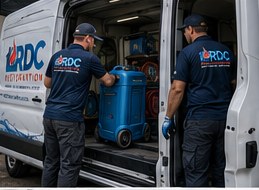
Professional technicians carry moisture meters, thermal cameras, commercial-grade drying equipment, and containment gear that a homeowner does not — and, just as important, we find and fix the source so the problem does not return. RDC Restoration serves all 21 New Jersey counties, dispatched 24/7 from hubs in Berkeley Heights and Piscataway, and we bill your insurance directly on covered losses. Call (908) 253-9000 and we can tell you over the phone whether you are describing a humidity issue or a water-intrusion one.
Simple maintenance that keeps humidity down
A dehumidifier is only half the battle. Pair it with a little seasonal upkeep and your basement stays dry with far less effort:
- Rinse or replace the dehumidifier filter every few weeks during peak season
- Check the drain hose for kinks or clogs so it never backs up
- Keep a hygrometer downstairs and glance at it — aim to stay under 50 percent
- Clean gutters and extend downspouts so roof water lands away from the foundation
- Seal obvious cracks and gaps around pipe penetrations early, before they grow
Key takeaways
- Keep basement relative humidity under 50 percent to stop mold and musty odors
- A basement dehumidifier treats damp air, not liquid water intrusion
- Standing water, seepage, or efflorescence calls for waterproofing, not just a dehumidifier
- Size up and use a continuous drain so the unit runs unattended
- Call (908) 253-9000 for 24/7 help anywhere in New Jersey
Not sure if it is humidity or a real water problem? RDC Restoration answers 24/7.
Frequently asked questions
How do I know what humidity level my basement should be?
Aim for a relative humidity between 30 and 50 percent, measured with a small hygrometer left on a shelf. Above 50 percent, mold, dust mites, and that musty smell take over; below 30 percent is rarely a concern in a New Jersey basement.
Will a basement dehumidifier stop my basement from flooding?
No. A dehumidifier only removes moisture from the air. If water is physically entering through walls, cracks, or the floor, you need drainage and basement waterproofing to stop it at the source. A dehumidifier is a good partner to waterproofing, not a substitute.
Should I run my basement dehumidifier all year?
In most of New Jersey you will run it hardest from late spring through early fall, when outdoor humidity is highest. In dry winter months you can often dial it back or turn it off — just keep an eye on the hygrometer and restart it if humidity climbs back over 50 percent.
Can too much basement humidity actually cause mold?
Yes. Sustained humidity above 50 percent is enough for mold to colonize drywall, wood framing, and stored items even without any visible leak. If you already see or smell mold, RDC provides certified mold remediation and finds the moisture source feeding it.
Does RDC handle basements across all of New Jersey?
Yes — RDC Restoration serves all 21 New Jersey counties, dispatched 24/7 from Berkeley Heights and Piscataway, and carries IICRC, NORMI, and AHERA certifications with a 4.9-star rating. Call (908) 253-9000 anytime.
New Jersey’s trusted restoration team.
Water, fire, or mold trouble? RDC Restoration dispatches the nearest crew 24/7, statewide. Call (908) 253-9000 or request a free estimate.