
RDC Restoration Blog · New Jersey
What To Do in the First Hour of a Home Flood in New Jersey
In the first hour of a home flood in New Jersey, shut off the water source, cut the electricity to the affected area, move people and valuables to dry ground, document everything for insurance, and call a 24/7 restoration company. After nearly three decades of emergency calls across New Jersey, I can tell you the single biggest factor in how much a flood costs you is how fast the water is extracted and the structure is dried — mold can begin within 24 to 48 hours, so what you do in that first hour genuinely changes the outcome.
Why the first hour of a home flood matters most
Water damage is not a single event — it is a clock that starts the moment water touches a porous material. Drywall, carpet padding, subfloor, and insulation all act like sponges, wicking moisture up walls and sideways under flooring far beyond the visible wet line. Within hours you can have saturated wall cavities that look dry on the surface. Within a day or two, that trapped moisture becomes the perfect breeding ground for mold, and the repair conversation shifts from “dry it out” to “tear it out.” Acting decisively in the first hour is the cheapest, most effective thing a homeowner can do.
New Jersey homes are especially exposed. Older housing stock in towns across Union, Essex, and Middlesex counties often has finished basements, aging supply lines, and hillside lots that funnel storm water toward the foundation. Whether the trigger is a burst pipe in January or a summer downpour overwhelming a sump pump, the response window is the same.
Stop the water and make the area safe
Your first job is to stop more water from coming in. If the source is a burst pipe, a failed water heater, or an overflowing appliance, shut off the main water valve — usually located where the supply line enters the home, near the water meter or in the basement. If the water is storm intrusion from outside, you may simply have to wait for the level to recede while you protect what you can inside.
Cut the power before you touch the water
Standing water and electricity are the most dangerous combination in any home flood. Never wade into water near outlets, appliances, or the electrical panel. Cut the power to the affected area at the breaker first. If you cannot reach the panel without stepping into water, leave the power off, stay out, and call an electrician or your utility. No belonging is worth an electrical shock.
Protect people, pets, and valuables
Once the area is safe, move family members and pets to dry ground — especially children, older adults, and anyone with asthma or respiratory sensitivity, since flood water and the humidity that follows can aggravate breathing. Then triage your belongings:
- Lift furniture legs onto blocks or aluminum foil so they stop wicking water and staining carpet
- Pull area rugs off wet carpet before the dyes bleed through
- Move electronics, photos, documents, and irreplaceable items to a dry upper floor
- Watch overhead — wet drywall and insulation get heavy fast and a soaked ceiling can sag or collapse
Document the home flood damage before you clean
Before you move or throw away anything, photograph and video everything: the standing water depth, damaged walls and floors, soaked belongings, and the source of the leak if you can see it safely. New Jersey insurers want two things — proof of the loss and proof that you took reasonable steps to prevent further damage. Keep receipts for anything you buy during the emergency, from a wet-vac to a tarp to a hotel room. At RDC Restoration we document the loss with moisture readings and photos and bill your carrier directly wherever possible, which removes a huge amount of stress from an already bad day.
Start drying — then call certified professionals
If the weather outside is dry, open windows, run fans, and mop or wet-vac what you can safely reach. Every bit of standing water you remove helps. But be honest with yourself about the limits of household equipment. Box fans move air across a surface; they do not pull moisture out of a subfloor or a wall cavity, and they cannot lower the humidity in a closed New Jersey basement.
Why household fans are not enough
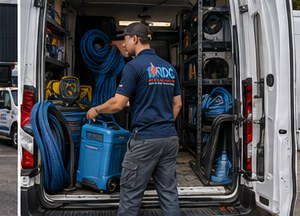
Professional structural drying is a controlled process. Truck-mounted extraction pulls water out of carpet, padding, and subfloor. Commercial air movers create the airflow that lifts moisture out of building materials, and industrial dehumidifiers capture that moisture from the air so it cannot resettle. Our technicians follow IICRC standards for water damage restoration and take daily moisture meter readings so drying is verified with numbers, not guesswork. That is the difference between a home that is dry in days and one that grows a mold problem in weeks — and if mold has already taken hold, our mold remediation team can contain and remove it safely.
What not to do after a home flood
Just as important as the right moves are the mistakes that turn a manageable loss into a major one:
- Do not enter standing water near any source of electricity
- Do not use a household vacuum to suck up water — it is a shock hazard and will destroy the vacuum
- Do not assume it will dry on its own; hidden moisture is what breeds mold
- Do not run the HVAC system if flood water reached the ducts or air handler, which can spread contamination
- Do not throw away damaged items before they are photographed for your claim
How RDC Restoration responds across New Jersey
RDC Restoration answers the emergency line 24/7 and serves all 21 New Jersey counties, dispatched from hubs in Berkeley Heights (Union County) and Piscataway (Middlesex County) so we can reach nearby towns quickly — often on-site within about an hour. We are BBB A-rated with a 4.9-star reputation, our technicians hold IICRC, NORMI, and AHERA certifications, and we handle water, fire, and mold damage as well as long-term basement waterproofing so the same flooding does not happen twice. If your home floods, the fastest thing you can do after making the area safe is call (908) 253-9000. See the full list of towns we cover on our service areas page.
Key takeaways for the first hour of a home flood
- Shut off the water source and cut power to the wet area
- Move people, pets, and valuables to dry ground
- Photograph and video everything before cleanup
- Call (908) 253-9000 for 24/7 professional extraction and drying
Dealing with a home flood in New Jersey right now? RDC Restoration answers 24/7.
Quick answers
Frequently asked questions
How fast do I need to act after a home flood?
Immediately. Mold can start within 24 to 48 hours and building materials keep absorbing water every hour, so extraction and structural drying should begin the same day the flood happens.
Will my New Jersey homeowners insurance cover a home flood?
Sudden, accidental water damage — like a burst pipe or failed water heater — is usually covered; gradual leaks and outside flood water often are not and may require separate flood insurance. RDC documents the loss and bills your carrier directly wherever possible.
Can I just dry out a flooded room myself?
For a small, clean spill, maybe. For any real flooding, professional extraction and structural drying are far more reliable at beating mold and finding the hidden moisture inside walls and subfloor that household fans never reach.
What should I not do during a home flood?
Do not enter standing water near electricity, do not use a household vacuum on water, do not run HVAC if flood water reached the ducts, and do not wait to see if it dries on its own.
Does RDC serve my area of New Jersey?
Yes — RDC Restoration serves all 21 New Jersey counties, dispatched 24/7 from Berkeley Heights and Piscataway. Call (908) 253-9000 and we will send the nearest crew.
New Jersey’s trusted restoration team.
Water, fire, or mold trouble? RDC Restoration dispatches the nearest crew 24/7, statewide.