RDC Restoration Blog · New Jersey
How Much Does Sewage Cleanup Cost in New Jersey?
Sewage cleanup cost in New Jersey is not a single number, because a sewage backup that floods one basement is rarely the same job as the one next door. Sewage is contaminated water, and the safety requirements are what set the price — not just the gallons on the floor. Below, I explain honestly what drives sewage cleanup cost up or down, why a written price after an inspection beats any figure quoted over the phone, and how insurance can make the whole thing manageable.
Why sewage cleanup is not priced like a normal water job
A clean-water leak and a sewage backup can flood the same finished basement, but they are not the same job. Sewage is Category 3 water — the most contaminated classification in the restoration industry — carrying bacteria, viruses, and other pathogens. That single fact changes everything about how the work is done, and therefore what it costs. In 27 years restoring New Jersey homes, the biggest misunderstanding I run into is the assumption that cleanup means pumping the water out. With sewage, extraction is only the beginning.
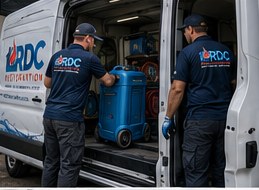
Because of the contamination, sewage cleanup requires containment to stop the spread, personal protective equipment for the crew, antimicrobial treatment of every salvageable surface, and safe disposal of anything porous the water touched. Those steps are non-negotiable, and they are the reason the price sits above a simple extraction and dry-out. RDC Restoration follows IICRC standards for Category 3 water, which spell out exactly how contaminated-water losses have to be handled to be safe.
What drives sewage cleanup cost up or down
There is no honest flat rate for sewage cleanup cost, because the same backup can be minor in one home and a major job in another. These are the factors that actually move the number:
- Volume and area affected. A small overflow contained to one bathroom is a world apart from raw sewage spread across a finished basement with multiple rooms.
- How long it sat. Contamination spreads and soaks in over time, so a fast response almost always costs less than a backup that sat for days before anyone called.
- What it soaked. Porous materials like carpet, pad, drywall, and insulation that absorb Category 3 water usually must be removed and replaced — that adds both labor and materials.
- Finished vs unfinished space. A finished basement with flooring, walls, and stored belongings costs more to restore than bare concrete you can clean and dry.
- The source. A simple clog is different from a collapsed main line or a recurring backup where the underlying cause has to be addressed to keep it from happening again.
- Structural drying. After decontamination, the space still has to be dried and verified with moisture meters, the same as any water damage restoration job.
What a professional sewage cleanup actually includes
When you see the sewage cleanup cost, this is the work it pays for — a safe, contamination-controlled process, not just water removal:
- Containment to keep contamination from spreading through the rest of the home.
- Extraction of the contaminated water and any solids.
- Removal and disposal of porous materials that cannot be safely cleaned.
- Cleaning and antimicrobial treatment of every salvageable surface.
- Structural drying with documented moisture verification.
- Deodorizing that removes the smell at its source instead of masking it.
- Post-cleanup checks for lingering moisture that could later feed mold growth.
Why a phone quote is a red flag
Any company that gives you a firm sewage cleanup cost over the phone is guessing, because they cannot see how far the contamination spread, what it soaked, or how long it sat. A responsible estimate comes only after a technician looks at the actual damage. RDC gives a written price after a free on-site inspection, so the number reflects your basement specifically — not a generic New Jersey average pulled from a chart. If a quote sounds suspiciously exact before anyone has walked your property, treat it as a warning sign.
Does insurance cover sewage cleanup cost?
This is where sewage cleanup cost often becomes manageable. Many homeowners policies exclude sewer and drain backups unless you carry a specific water backup endorsement — an inexpensive add-on that a lot of New Jersey homeowners do not realize they are missing until they need it. If you have that endorsement, a meaningful share of the cost may be covered. RDC bills most insurers directly and documents the loss to industry standards, so if you are covered, you are not fronting the entire bill and waiting to be reimbursed. When you call, ask us to walk you through what your policy likely does and does not include before the work starts.
How to keep sewage backups from repeating
Paying for cleanup once is bad enough; paying for it twice is worse. If your backup traced to groundwater or a chronically wet basement rather than a one-time clog, addressing the water source matters as much as the cleanup. Our basement waterproofing work targets the conditions that let water and sewage intrude in the first place. And because RDC serves all 21 New Jersey counties from dispatch hubs in Berkeley Heights and Piscataway, we can get to most of the state quickly — you can confirm coverage for your town on our service areas page.
Do not wait to call
Sewage is a genuine health hazard, and every hour it sits, contamination spreads and the sewage cleanup cost climbs. This is not a DIY project. RDC Restoration is IICRC-certified for Category 3 work, holds NORMI and AHERA credentials, carries a BBB A rating with a 4.9-star reputation, and responds 24/7 from Berkeley Heights and Piscataway across all of New Jersey. Call (908) 253-9000 for a free inspection and a written price based on what is actually in your home.
Frequently asked questions
How much does sewage cleanup cost in NJ?
Sewage cleanup cost varies widely based on how much area is affected, how long it sat, what materials it soaked, and whether the space is finished. Because contamination and hidden soaking cannot be judged over the phone, RDC gives a written price after a free inspection rather than a flat rate.
Why is sewage cleanup more expensive than water cleanup?
Sewage is Category 3 water, contaminated with bacteria and pathogens. That requires containment, protective equipment, antimicrobial treatment, and safe disposal of the porous materials the water touched, on top of the drying any water job needs. Those safety steps are what drive the higher cost.
Does insurance cover sewage backup cleanup?
Often only if you carry a water backup or sewer backup endorsement, which many homeowners policies exclude by default. It is an inexpensive add-on worth checking on your policy today. RDC bills most insurers directly and documents the loss to support your claim.
Can I clean up sewage myself?
It is not recommended. Sewage carries real health risks and requires proper containment, antimicrobial treatment, and disposal to handle safely. RDC is IICRC-certified for Category 3 work and available 24/7 at (908) 253-9000.
How fast can RDC respond to a sewage backup in New Jersey?
RDC runs a 24/7 emergency line and dispatches from Berkeley Heights and Piscataway to all 21 New Jersey counties, so we can typically reach most of the state quickly. Faster response usually means less contamination spread and a lower overall sewage cleanup cost.
Dealing with a backup right now? Do not wait for it to spread. Call RDC Restoration at (908) 253-9000 or contact us here for a free inspection and an honest, written sewage cleanup cost for your home.
Related reading
More from the RDC Restoration blog
Water, fire, or mold damage in New Jersey?
RDC Restoration answers 24/7 with certified crews from Berkeley Heights & Piscataway — fast response, direct insurance billing.