
RDC Restoration Blog · New Jersey
Frozen Pipes in NJ: Prevention and Thaw Safety
Frozen pipes are one of the most common winter emergencies we see across New Jersey, and they can turn a quiet January night into a flooded first floor in minutes. A frozen pipe expands until the line splits, and the moment it thaws, hundreds of gallons pour into walls, ceilings, and basements. The good news: with steady heat, a few minutes of prep, and a calm response when the temperature drops, most frozen pipes are entirely preventable.
Why frozen pipes are such a New Jersey problem
New Jersey winters swing hard. A mild week can drop into single digits overnight, and that sudden plunge is exactly when frozen pipes catch homeowners off guard. Older homes across Union, Middlesex, Essex, and Bergen counties often run water lines through uninsulated exterior walls, unheated basements, crawl spaces, and garages — the coldest parts of the house. Add a windy night, a thermostat set back to save on heating, and a pipe on the wrong side of the insulation, and you have the recipe for a burst.
Water in a pipe freezes from the outside in. As the ice grows it does not push against the faucet — it pushes against the closed section of pipe, and the pressure between the ice blockage and the fixture is what actually splits the line. That is why a pipe can look fine while frozen and only fail once it starts to thaw.
How to prevent frozen pipes before the cold hits
Prevention is cheap; a burst line is not. Before the first hard freeze of the season, walk your home and knock out the basics:
- Insulate exposed pipes in the basement, garage, crawl space, and along exterior walls with foam pipe sleeves — a few dollars a length at any hardware store.
- Seal drafts near pipes: caulk gaps, close crawl-space vents, and weatherstrip the garage door so cold air cannot pool around plumbing.
- Disconnect garden hoses and shut off and drain outdoor spigots and irrigation lines before the first freeze.
- Know where your main shutoff valve is and make sure it turns freely, so you can stop the water fast if a pipe does burst.
- Keep the heat on — even in unused rooms and even when you travel — and never let the house drop below 55°F.
During a deep freeze or a cold snap
When the forecast calls for a hard overnight low, add these steps:
- Let vulnerable faucets drip. A trickle of moving water relieves pressure and makes freezing far less likely.
- Open cabinet doors under kitchen and bathroom sinks so warm room air reaches the pipes behind them.
- Hold a steady thermostat. Skip the deep nighttime setback during the coldest nights — the small heating savings is not worth a burst pipe.
- If you leave town, shut off the main water supply and drain the system, or have someone check the house daily.
What to do the moment a pipe freezes
If no water comes out of a faucet on a cold morning, you likely have a frozen pipe that has not yet burst — and you have a window to act. Open the faucet so water can flow once the ice melts, then warm the frozen section slowly. A hair dryer, a space heater kept clear of anything flammable, or towels soaked in hot water all work. Start warming nearest the faucet and move back toward the cold spot.
Never use a blowtorch, propane heater, or any open flame to thaw a pipe — it is the leading cause of winter house fires and can crack the pipe outright. If you cannot locate the frozen section, cannot reach it, or the pipe will not thaw, shut off the main valve and call a plumber before the line fails.
If a frozen pipe has already burst
A burst line is an emergency. Move fast and in order:
- Shut off the main water valve immediately to stop the flow.
- Cut the power to any area where water is near outlets, wiring, or the electrical panel.
- Move belongings out of the water and lift furniture off wet carpet.
- Call for professional extraction right away — the longer water sits, the deeper it wicks into drywall, subfloor, and framing.
RDC Restoration answers its emergency line 24/7 at (908) 253-9000 and dispatches a certified crew for fast water damage restoration anywhere in New Jersey. If the water reached a finished basement, ask us about basement waterproofing so the next freeze — or the next heavy rain — does not do it again.
Why fast response matters after a burst pipe
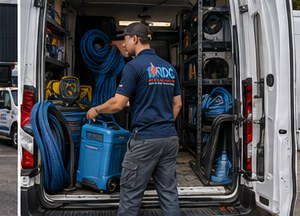
Restoration is a race against the clock. Standing water begins soaking into porous materials within minutes, and mold can take hold within 24 to 48 hours. Because RDC Restoration dispatches from two central hubs — Berkeley Heights in Union County and Piscataway in Middlesex County — a certified crew reaches most New Jersey addresses while the damage is still containable, which protects your family’s health and keeps the total repair cost down. Our technicians hold IICRC certifications (WRT and ASD) and follow recognized industry standards for structural drying, so the walls and floors we save are actually dry — not just dry to the touch. Where water sat long enough to start a colony, our mold remediation team contains and removes it properly.
Insurance and documentation
Most New Jersey homeowner policies cover sudden, accidental damage from a burst pipe — but the outcome of a claim often comes down to documentation. Photograph everything before you clean up, keep receipts for anything you spend, and mitigate promptly, since policies require you to prevent further loss. RDC Restoration produces a detailed, itemized loss report and bills your carrier directly wherever possible, which strengthens and speeds your claim. We serve all 21 New Jersey counties; see our service areas to confirm coverage for your town.
Key takeaways
- Frozen pipes are preventable — insulate, seal drafts, and keep the heat above 55°F
- During a deep freeze, drip faucets and open cabinet doors
- Thaw a frozen pipe slowly — never with an open flame
- If a pipe bursts, shut off the main valve and call for extraction immediately
- Document everything for your insurance claim
Dealing with a burst or frozen pipe in New Jersey right now? RDC Restoration answers 24/7.
Quick answers
Frequently asked questions
At what temperature do pipes freeze in New Jersey?
Frozen pipes generally become a risk once the outdoor temperature drops to about 20°F or below, especially overnight with wind. Pipes in uninsulated exterior walls, basements, and crawl spaces are the first to go, which is why insulation and a steady indoor temperature matter most.
How do I thaw a frozen pipe safely?
Open the faucet, then warm the frozen section slowly with a hair dryer, a space heater, or hot-water-soaked towels, working from the faucet back toward the cold spot. Never use an open flame or blowtorch. If you cannot reach or thaw the pipe, shut off the main valve and call a plumber.
My pipe already burst — what do I do first?
Shut off the main water valve immediately, cut power to any wet area, and call RDC Restoration at (908) 253-9000 for emergency water extraction. Fast removal limits how far the water spreads and how much mold follows.
Does RDC Restoration handle burst-pipe cleanup in my New Jersey town?
Yes — RDC serves all 21 New Jersey counties, dispatched 24/7 from Berkeley Heights and Piscataway. Most nearby towns see a crew within about an hour, day or night.
Will my insurance cover a burst frozen pipe?
Most New Jersey policies cover sudden, accidental damage from a burst pipe. RDC documents the loss thoroughly, provides an itemized report, and bills your carrier directly wherever possible to support and speed your claim.
New Jersey’s trusted restoration team.
Frozen pipe, burst line, or any water trouble? RDC Restoration dispatches the nearest certified crew 24/7, statewide. Call (908) 253-9000 or request a free estimate.