
RDC Restoration Blog · New Jersey
Does Homeowners Insurance Cover Water Damage in New Jersey?
Does insurance cover water damage in New Jersey? In most cases, yes — a standard homeowners policy pays for sudden, accidental water damage such as a burst pipe or an overflowing appliance, but it will not cover gradual leaks, deferred maintenance, or flooding from outside, which needs separate flood insurance. The gap between an approved claim and a denied one almost always comes down to two things: how quickly you document the loss and how fast you mitigate it.
The short answer: does insurance cover water damage?
Whether insurance covers water damage hinges on one phrase buried in your policy: “sudden and accidental.” New Jersey homeowners policies are designed to pay for losses that happen abruptly and by chance — a pipe that splits in a January cold snap, a supply line that lets go behind the dishwasher, a water heater that ruptures overnight. Those are textbook covered events. What insurers push back on is damage they can frame as preventable: a leak you knew about and ignored, rot that built up over years, or backups tied to a system you never maintained. Reading your declarations page before an emergency is the best way to avoid a surprise at claim time.
Sudden and accidental vs. gradual: what NJ policies cover
Because coverage turns on how the damage started, it helps to sort common New Jersey scenarios into two buckets. Here is how carriers typically treat them — though your specific policy and endorsements always control the final answer.
Usually covered:
- A burst or frozen pipe that releases water suddenly
- An overflowing washing machine, dishwasher, or water heater failure
- Storm damage that lets rain in through a roof breach caused by wind
- Accidental overflow from a plumbing or HVAC system
- Water damage from putting out a house fire
Usually not covered:
- Slow, long-term leaks under a sink or behind a wall
- Damage traced to poor maintenance or an unrepaired defect
- Groundwater seepage through a foundation or basement wall
- Sewer or drain backups without a specific backup endorsement
- Flooding from rivers, heavy rain, or storm surge (needs flood insurance)
Do not self-diagnose and stay quiet. Even when you are unsure, report the loss and let the adjuster rule — but photograph and document everything first, before any cleanup begins.
Where flood insurance fits in New Jersey
One of the most common and costly misunderstandings in the state is assuming a homeowners policy covers flooding. It does not. Rising water — whether from a swollen river, a coastal surge, or rain that overwhelms the ground and runs into your home from outside — is excluded from standard policies statewide. That coverage comes only through separate flood insurance, most often a policy backed by the National Flood Insurance Program (NFIP) or a private flood carrier. Given how much of New Jersey sits in or near a flood zone, it is worth asking your agent where your address falls. If you are fighting recurring water intrusion at the foundation, that is a drainage problem, not an insurance one — and basement waterproofing is the durable fix.
How to file a water damage insurance claim in New Jersey
A calm, methodical first hour protects both your home and your claim. Whenever insurance covers water damage, the payout still depends on the paper trail you build in those early moments. Here is the sequence we walk New Jersey homeowners through:
- Stop the source safely. Shut off the water main or the local valve, and cut power to affected areas if it is safe to reach the panel.
- Document before you touch anything. Take wide and close-up photos and video of standing water, soaked materials, and damaged belongings.
- Report the loss promptly. Call your insurer to open a claim and write down your claim number and adjuster contact.
- Begin reasonable mitigation. Your policy legally requires you to prevent further loss — extract water and start drying rather than letting it sit.
- Keep every receipt. Save records for temporary repairs, equipment, and lodging if your home is unlivable.
- Get a professional loss assessment. A certified restoration report carries far more weight with an adjuster than a homeowner’s estimate.
Do not throw away damaged materials until the adjuster has seen them or given you the go-ahead in writing — discarded evidence is one of the fastest ways to weaken an otherwise valid claim.
Why prompt mitigation protects your claim
Restoration is a race against the clock, and so is your coverage. Water begins feeding mold within 24 to 48 hours, drywall wicks moisture upward by the hour, and hardwood floors cup and buckle as they absorb it. Insurers know this, which is why nearly every policy contains a “duty to mitigate” clause: if you delay and the damage spreads, the carrier can deny the portion of the loss that reasonable action would have prevented. Fast, documented mitigation does double duty — it shrinks the physical damage and it demonstrates to the adjuster that you acted responsibly. When secondary problems like mold take hold, both the repair bill and the coverage fight get harder.
When to call a professional
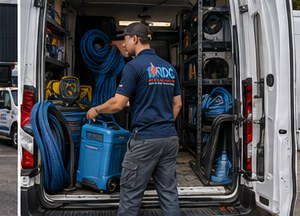
You can handle a small, clean spill with towels and a fan. Call a professional the moment water damage restoration involves contaminated or gray water, a large footprint, moisture hidden behind walls or under floors, or any health concern. Certified crews carry moisture meters, thermal cameras, commercial air movers, and containment gear that a homeowner simply does not have — and, just as important, they trace the water to its source and stop it so the problem does not return. RDC Restoration follows the drying and remediation standards published by the IICRC, and our technicians hold IICRC, NORMI, and AHERA certifications. That training is what turns a soaked room into a properly dried, documented, and claim-ready one.
How RDC strengthens your water damage insurance claim
Beyond the drying itself, the biggest favor a restoration company can do you is build a claim your carrier cannot easily dispute. RDC Restoration produces a detailed, photo-backed loss report, records moisture readings before and after drying, and bills your insurance carrier directly wherever possible — so you are not floating the cost or arguing line items alone. With 27 years of experience, a BBB A rating, and a 4.9-star reputation across New Jersey, our crews dispatch 24/7 from hubs in Berkeley Heights (Union County) and Piscataway (Middlesex County) to reach all 21 counties. Call (908) 253-9000 and a certified technician can be on the way while the damage is still containable.
Key takeaways
- Sudden, accidental water damage is typically covered; gradual leaks and outside flooding are not
- Flooding needs separate flood insurance — a homeowners policy will not cover it
- Document everything before cleanup and mitigate promptly to protect your claim
- A certified loss report carries more weight with an adjuster than a homeowner estimate
- Fix the source, not just the symptom, so the damage does not return
Dealing with water damage in New Jersey right now? RDC Restoration answers 24/7.
Quick answers
Frequently asked questions
Does homeowners insurance cover water damage from a burst pipe in New Jersey?
Yes — a burst or frozen pipe is a classic “sudden and accidental” loss, so a standard New Jersey homeowners policy typically covers the resulting water damage. Document the scene and mitigate promptly, then call RDC at (908) 253-9000.
Does insurance cover water damage from rain or flooding?
Not under a standard homeowners policy. Rising water and outside flooding are excluded and require separate flood insurance, usually through the NFIP or a private flood carrier.
Will insurance cover water damage from a slow leak?
Usually not. Insurers treat long-term, gradual leaks as a maintenance issue rather than a sudden accident, so that damage is commonly denied. Reporting and repairing leaks early is the best protection.
How soon should I start cleanup after water damage?
Immediately. Water feeds mold within 24 to 48 hours, and your policy requires you to prevent further loss — but photograph everything before you begin, and keep damaged materials until the adjuster approves disposal.
Does RDC Restoration bill my insurance directly?
Wherever possible, yes. RDC documents the loss thoroughly, produces a claim-ready report, and bills your carrier directly. We serve all 21 New Jersey counties 24/7 from Berkeley Heights and Piscataway.
Related reading
More from the RDC Restoration blog
- Asbestos in Older NJ Homes: Testing and Safe Removal
- Best Water Damage, Fire & Mold Restoration Companies in Berkeley Heights, NJ
- Best Water Damage, Fire & Mold Restoration Companies in Essex County, NJ
- Best Water Damage, Fire & Mold Restoration Companies in Somerset County, NJ
- Water damage restoration in NJ
New Jersey’s trusted restoration team.
Water, fire, or mold trouble? RDC Restoration dispatches the nearest crew 24/7, statewide. Call (908) 253-9000 or request a free estimate.